The automatedexaminer.
Photograph a handwritten answer script. AutoEx reads it, scores it against the keywords you set, explains every mark, and reports on the whole class — in minutes, not evenings.
How it works
The paper's process flow, Fig. 2See two stages run
Right here, in your browserStage 1 — segmentation, in your browser
Thresholding…
Stages 3–4 — correction and matching
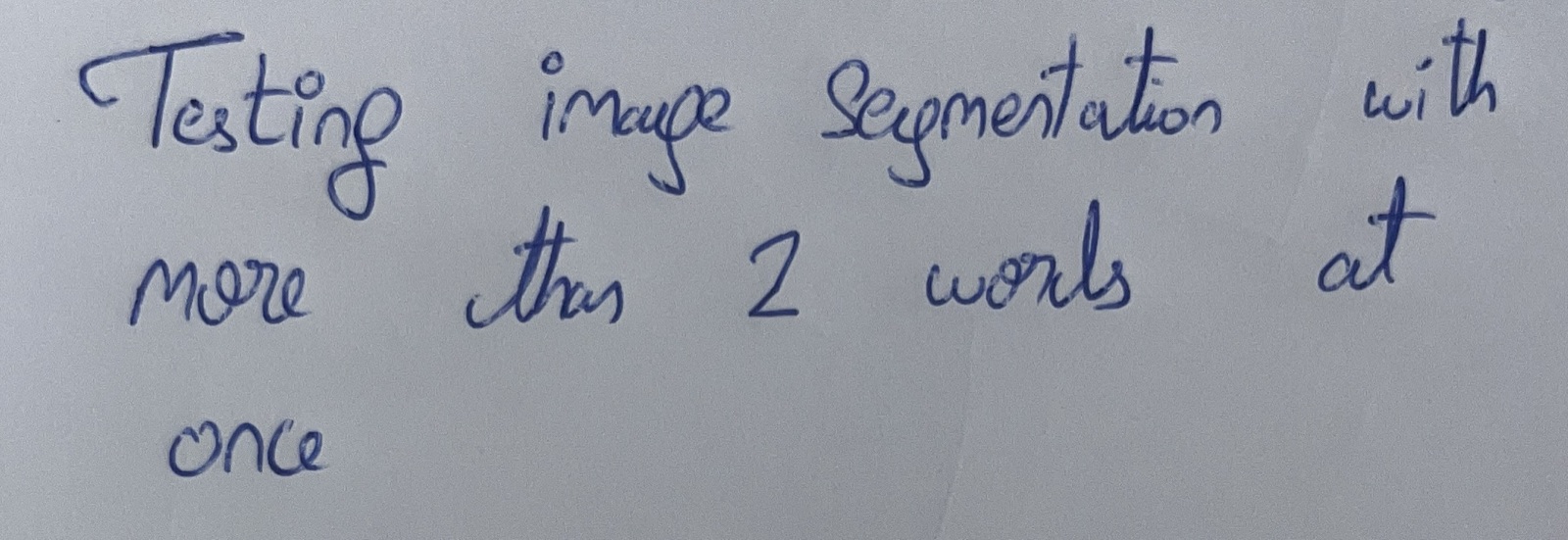
Testing image segmentation with more than 2 words at once
Plurals match by stem; a misspelling within one edit (two for long words) matches fuzzily. Exact hits are solid, fuzzy ones dashed.
What the examiner gets
Each question lists the keywords found, as the student wrote them, and how they matched. Nothing is a black box — change a keyword and the whole class re-scores.
Equal splits a question's marks evenly across its keywords. Custom lets you weight the concepts that matter. Marks never exceed a question's maximum.
Mean, standard deviation, a grade distribution (absolute bands or the class's own quartiles), a linear model, and the keywords the class missed most.
A vision model in the cloud (Gemini) for cursive and messy scripts, or on-device Tesseract when a page must not leave the room. Every transcription can be corrected by hand.
Exams, scripts and marks live in your browser's storage. No accounts, no database, no student data on our servers.
One click exports the mark sheet — student, per-question marks, total, percentage, grade — ready for a spreadsheet or the institution's system.
The research behind it
AutoEx began as a university course project and became a peer-reviewed paper: handwriting is segmented with contour analysis, read by a CNN–RNN network trained with CTC loss (cascaded with Apple's Vision framework), corrected with an NLP pipeline and scored by keyword weightage. Its reported word error rate was 5.6%.
This web version keeps the method and swaps the parts that needed a laptop for parts that run anywhere: the segmenter runs in the browser, the reader is a vision model, the R interface became this.
Design of automated model for inspecting and evaluating handwritten answer scripts: A pedagogical approach with NLP and deep learning
Alexandria Engineering Journal, Volume 108 (2024), pp. 764–788. Open access (CC BY-NC-ND).
The original research code — the TensorFlow model, the OpenCV segmenter, the R Shiny interface — is on GitHub ↗.
Mark your first script
Pick a sample exam — the questions, keywords and scripts are already in it — and press read.
Open the examiner